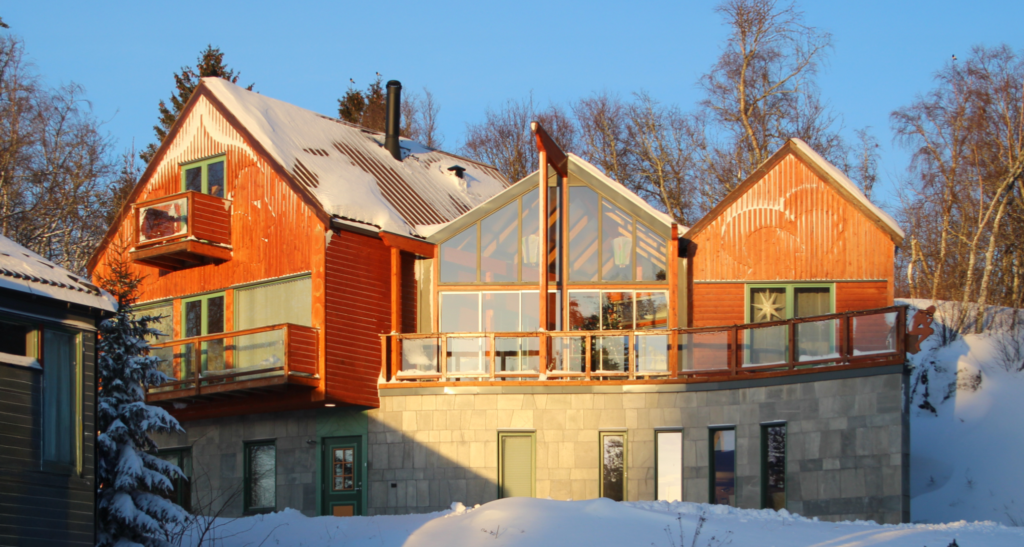
A Dream Home is created
My fascination with architecture, particularly as an interplay of shapes and colors, has always been there. As a child, I would spend hours playing with wooden blocks, stacking them one on top of the other to build a tower; but the most exciting task was to build a “palace,” a nice composition of stacked blocks. I remember that the palace always had an entrance, stairs, and elaborate shapes on the roof.
The blocks came in a variety of shapes and colors; most were cubes, some were long and thin like beams, a few resembled circular columns, and other arches. I remember exploring overlays by offsetting the upper block, seeking a degree of overhang that felt visually engaging.
Color has always been an important feature. Some blocks were painted different colors on different sides; rotating a cube 90 degrees could produce a completely different effect. To make a cohesive composition, the same color had to be used, while different colors divided large shapes into smaller pieces. Perhaps certain aesthetic preferences had already developed at that time.
Later, my interest in light emerged. As a child, I spent a lot of time trying to understand the patches and spots of light that occasionally appeared around me, and then I tried to create similar ones myself using mirrors and shiny objects like spoons.
I gradually understood that architecture is much more complex than the composition of shapes in light, as the famous French architect Le Corbusier announced in 1900. Architecture is about designing spaces for people (and other living organisms). Hundreds of technical aspects must be considered to create safe, comfortable and sustainable buildings.
Buildings are seen from different distances, the play of large volumes dominate when perceiving buildings from far away, but from a short distance the architectural details creates the impression, they decide if the building appears as well designed, nice, inviting, open, generally interesting to look at or if it makes you indifferent.
One of the topics I stumbled over during my academic career was the visual effect of fluctuating surfaces. I experimented with varying degrees of protrusion and depth, exploring the forms that emerged by allowing the surface to fluctuate.
The inspiration for creating reliefs of wooden sticks on the facades came from the works of fine artist Edith Lundebrekke, https://www.norskekunsthandverkere.no/kunstnerregister/edith-lundebrekke, who made numerous works with linear-vertical wooden sticks. The sticks in many of her works are painted in chromatic colors (each side in different color) and assembled closely together such that new colors appear in the spaces between sticks through inter-reflection of light between them and the background. Her works have abstract, geometric, and non-figurative in design.
The partnership with Karstein Sørli opened a new path in the search for new forms of expressions and novel methods of creating reliefs. He introduced the use of a CNC machine to engrave forms into wooden surfaces. Reliefs could be created by following lines of a drawing by a graver (stylus), instead of a pencil or a pen. The lines of a drawing are engraved in the material, like for example the scriptures on the old Egyptian temple walls. Use of the CNC technic enable huge variation; the engraved lines may differ in thickness and depth. Engraving offers greater durability, it cannot be easily wiped off the surface. Additionally, it involves light as a crucial actor as the darkness of the shadows appearing in the cuts depends very much on illumination.
The process of designing and building the house was an exciting and rewarding way to discover new possibilities, test them, and apply them immediately. In a way, each architectural element, each detail is a new experiment, new discovery, both on the aesthetic and technical plan. The process could not have been so fruitful without harmonic cooperation between two people having mutual respect, trust and love for each other.
The main motivation for writing this book was to offer an example of how architecture might evolve once \emph{the black-box trend} currently dominating Trondheim has passed.
In recent decades, a trend has emerged in architecture that can be described as a combination of pragmatism, minimalism, and sustainable development. It is defined by minimalism in form and shape, restrained use of color, and a fluid definition of space. Sustainability is primarily implemented through building installations. In the wooden architecture of small houses in Trondheim, pragmatism is expressed in rectangular house shapes of very dark colors or simply black. For simplicity, we’ll call this trend black box.
We wonder what’s so beautiful, pleasant and attractive about black boxes. Why black and why boxy? The black color of a building facade negatively affects the well-being of people passing by, making us serious and sad. It’s no coincidence that black is the color used at funerals. Anyone who has seen the house after the fire has been extinguished will always remember the black, charred walls without windows. The feeling of sadness intensifies in cloudy weather. In winter, when we need joy and optimism to overcome the winter blues, the sight of a black box house depresses us even more.
The box shape is the simplest and cheapest possible shape, very easy to grasp visually and very easy and inexpensive to build. It is not exciting, it doesn’t capture our imagination; it does not awake memories, it doesn’t tell a story, we simply don’t expect anything. We pass by a box indifferently; in a sense, it doesn’t matter whether it exists or not. Also, the flat roof in “black box” houses conflicts with the good and safe building tradition.
The black box trend will inevitably end someday, just as it did with previous trends and styles. We believe this book, presenting an orange wooden house with a saddle roof and innovative facade designs, can serve as inspiration for the future.
Barbara Matusiak
Trondheim, December 2025